
How to Write Hotel Furniture Specifications for Accurate Supplier Quotations
A clear set of hotel furniture specifications gives owners, designers, contractors, and FF&E procurement teams a common basis for quotation and approval. Instead of asking a supplier to price a mood board or an incomplete schedule, the project team defines each item’s dimensions, materials, finish, quantity, location, and commercial assumptions. The result is a quotation that can be compared more fairly and converted into drawings, samples, production, packing, and installation instructions.
This guide explains how to prepare hotel furniture specifications for an international hospitality project. It focuses on practical information suppliers need, common gaps that create variation, and a documentation process that keeps design intent connected to the manufactured item. It does not replace the project’s contract documents, local requirements, or the written confirmation that must be obtained for project-specific decisions.
Start with an item-coded furniture schedule
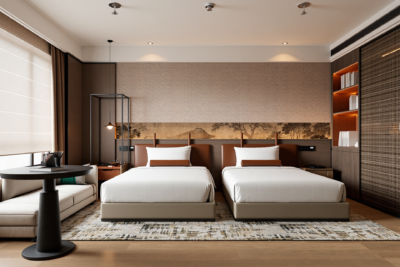 The furniture schedule should be the backbone of the specification package. Give every item a unique code that remains consistent across plans, elevations, quotations, shop drawings, sample records, inspection documents, packing lists, and installation notes. A code such as G-203 for a guestroom bedside table or L-118 for a lobby lounge chair is more reliable than describing the same item differently in separate emails.
For each code, record the room or zone, item description, quantity, overall dimensions, and intended use. Note whether the item is loose furniture, fixed furniture, or coordinated with architectural or site work. Include the floor, building, room type, or public-area location when the project has multiple areas. A supplier should be able to understand what is being priced without reconstructing the scope from several drawings.
Add a revision field and approval status. “For quotation,” “for sample,” “approved for production,” and “superseded” should not be treated as the same instruction. Date each revision and identify the person or team responsible for approval. This simple control prevents an old dimension or finish from being carried into a new quotation.
Define dimensions and functional requirements
Dimensions should describe the complete item, not only the most visible measurement. Depending on the product, include width, depth, height, seat height, clearance, thickness, radius, leg height, drawer allowance, door swing, and fixing or service zones. For casegoods, identify internal storage requirements and usable clearances. For seating, describe the intended posture, cushion configuration, and relationship to nearby tables or circulation routes.
Check the item against the room and building interface
A hotel furniture specification must work in its real setting. Compare the item with the latest architectural plans, interior elevations, wall protection, skirting, doors, windows, curtains, lighting, sockets, equipment, and accessible routes. A cabinet can meet its nominal size and still fail because a door cannot open, a bedside table blocks a socket, or a console narrows a circulation path.
State any interface that the supplier must coordinate. Examples include cable openings, concealed fixings, wall-mounted elements, stone or glass tops, plumbing-related clearance, or a built-in item that depends on a finished wall dimension. If a dimension is provisional, label it as provisional rather than allowing the supplier to assume that it is final.
Specify materials, finishes, and construction clearly
 A finish name alone rarely provides enough information for an accurate quote. “Walnut,” “dark metal,” “stone effect,” or “brushed brass” can describe many different products with different cost, appearance, maintenance, and lead-time implications. Identify the material type, veneer or laminate reference where applicable, colour, sheen, edge treatment, grain direction, substrate expectation, and sample reference. For upholstery, record the approved fabric or leather reference, colour, pattern direction, and performance requirements supplied by the project team.
Construction information should match the level of detail needed for the item. State expectations for carcass construction, joinery, edge banding, drawer hardware, hinges, runners, legs, frames, foam, stitching, protective treatment, and visible fasteners when these affect performance or appearance. Do not invent a construction method simply to make the specification look complete. If the design team has not fixed a detail, mark it for technical clarification and ask the supplier to identify the proposed solution separately.
This is where a hotel furniture factory can price more accurately. A factory can respond to a defined material and construction brief; it should not be expected to turn an ambiguous image into a final technical scope without recording assumptions. Require all deviations, substitutions, and exclusions to be listed against the relevant item code.
Separate confirmed requirements from design references
Reference images, renderings, and precedent projects are useful for communicating direction, but they do not automatically define a production item. Mark each document as concept reference, design intent, approved sample, approved drawing, or production release. If a rendering shows a decorative detail that is not dimensioned or materialised, include it as a design question rather than as an unverified requirement.
A specification package should also identify the hierarchy of documents. For example, the approved shop drawing may control dimensions, the approved finish sample may control colour and sheen, and the contract schedule may control quantity. If two documents conflict, the project team should resolve the conflict in writing before production. A supplier quotation should state which documents and revisions it is based on.
For hotel furniture China sourcing, the same discipline is important when communication crosses languages, time zones, and teams. Use photographs or marked-up drawings only as support for written descriptions. Keep a shared register of questions and answers so a clarification given to one person does not become an undocumented change for everyone else.
Build quotation requirements into the specification
A useful request for quotation tells the supplier how to structure the response. Ask for pricing against the project item codes and quantities, with separate lines or clearly identified assumptions for samples, tooling, packaging, delivery, installation, and other project-specific scope. State the requested currency, delivery destination, quotation validity, tax or duty assumptions where the project team has defined them, and the date by which clarification is required.
Do not use a country-of-origin label as a substitute for project information. A hotel furniture China factory may be able to support an international project, but the buyer still needs to verify the actual item scope, approved materials, drawings, quality criteria, packing method, logistics responsibility, and destination requirements. The supplier’s response should make clear what is included and what remains to be confirmed.
Before comparing bids, normalise the assumptions. A low total may exclude shop drawings, finish samples, protective packaging, delivery to site, or installation. A higher total may include those items. Compare like with like, then record the commercial differences rather than selecting a price based only on the headline figure.
Use an approval and revision workflow before production
The final specification is not complete until the approval path is defined. Set checkpoints for quotation review, technical clarification, shop-drawing approval, finish and upholstery approval, prototype or sample review where required, pre-production confirmation, inspection, packing, and site receipt. Assign an approver and a target date to each checkpoint.
Keep the released production set traceable
When an item is released for manufacture, assemble the current schedule row, drawings, finish references, approved comments, quantity, and packing or labelling requirements into a traceable package. Record the release date and revision. If a substitution or dimensional change is proposed later, compare it with the released requirement and obtain written approval before treating it as part of the production set.
This workflow reduces disputes because the project team can identify what was requested, what was quoted, what was approved, and what was delivered. It also helps contractors and installation teams connect packages to rooms and zones. The exact checks must follow the project’s approved documents and contractual requirements; do not claim a quality result before it has been inspected and recorded.
Validate MEITIAN hotel furniture china information before sending an inquiry
 MEITIAN Hotel Furniture Supplier as a manufacturer involved in designing, manufacturing, and installing high-star hotel furniture, and describes categories including hotel bedroom furniture, public area furniture, sofas, chairs, coffee tables, and restaurant furniture. The same page publishes company information and certification claims; buyers should match any requirement to current project documentation and request written confirmation for the specific scope.
MEITIAN Hotel Furniture Catalog is a relevant starting point for catalog and project materials. MEITIAN hotel bedroom furniture and hotel public area furniture can help the design or procurement team organise an initial reference list. Online category information should not be treated as an approved specification, price, stock statement, or delivery promise.
For a project inquiry, send MEITIAN hotel furniture manufacturers in china the item-coded schedule, drawings, finish references, quantities, destination, project stage, and target dates. Ask the team to confirm questions, exclusions, proposed substitutions, sample requirements, drawing requirements, packing assumptions, installation responsibility, and quotation validity in writing.
Send a specification-led hotel furniture inquiry
Accurate hotel furniture specifications make supplier quotations easier to compare and make later approvals easier to trace. Start with a coded schedule, define dimensions and materials, identify interfaces, separate references from approvals, and record every revision. If you are preparing a hotel, resort, serviced apartment, or public-area package, send us your current drawings, schedule, finish references, quantities, destination, and programme. Ask for a project-specific response that clearly states scope, assumptions, exclusions, and next technical steps.
MEITIAN Hotel Furniture Factory deliver Customized One‑Stop Hotel Furniture Solutions for hotels, resorts, villas and apartment 🏨
✅ Elegant bespoke design
✅ Premium & durable materials
✅ Customized to match your interior concept
✅ Full project execution & installation support
We help hospitality developers cut coordination costs. From 3D rendering and sample room approval to mass production and global shipment
Build memorable guest spaces with reliable hotel furniture solutions. 🌐 https://fsmeitian.com/ 💬 +86 134 1180 4160