
Hotel Furniture Materials: Lessons from a Maldives Hospitality Interior
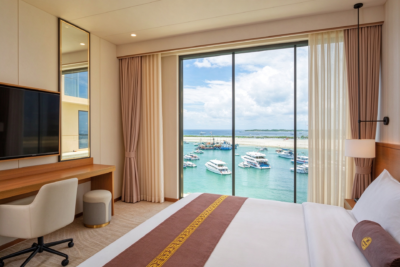
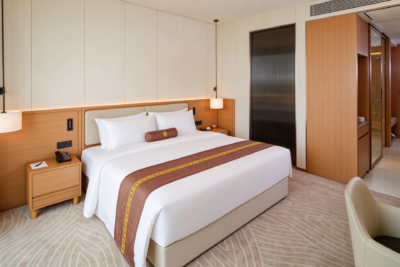
Hotel furniture materials influence far more than appearance. They affect comfort, cleaning, durability, repair, lighting, moisture management, and the way a guest remembers a room. The supplied images from the Manhattan Business Hotel case in Malé, Maldives show a calm hospitality interior built around warm wood-toned furniture, pale wall surfaces, transparent or fluted elements, soft textiles, large windows, and a green stone-like bathroom vanity.
These visible details provide a useful starting point for discussing materials, but photographs cannot establish the exact board, veneer, coating, stone species, or glass specification. Those details must be confirmed through approved samples and technical documents. The purpose of this case is to show how a hotel project can connect material choices to guest experience and daily operation.
The official Manhattan Business Hotel website presents the hotel for business and leisure guests and highlights daily maid service, in-room dining, 24-hour room service, and conference facilities. The furniture materials therefore need to support both visual calm and repeated service use.
Start with performance requirements, then choose the finish
 Material selection should begin with the environment and the task. A bedside table, desk, wardrobe interior, bathroom vanity, headboard, sofa, and lobby table do not experience the same wear. Each requires a different balance of appearance, touch, cleaning, moisture resistance, impact resistance, repairability, and cost.
Create a material matrix for each furniture group. Record the intended use, cleaning exposure, contact frequency, visible surface, edge condition, hardware, substrate, and replacement plan. This prevents a beautiful decorative finish from being specified for a surface that needs a stronger commercial solution.
The Manhattan guestroom images use a warm wood-toned language across several furniture zones. That continuity helps the room feel designed as a whole. A new project can achieve similar unity through coordinated colors, grains, edge details, or metal accents without assuming that every item should use exactly the same construction.
Add a simple risk rating to the matrix. Mark each surface as low, medium, or high exposure based on water, cleaning chemicals, luggage impact, sunlight, food and drink, or repeated handling. Then identify the consequence of failure: a visible scratch, a swollen edge, a difficult replacement, a guest comfort issue, or a room-out-of-service event. This makes material discussions more practical and helps the team focus testing on the surfaces that matter most.
Use wood tones to create warmth and orientation
Wood-look furniture can make a hotel room feel warmer and more residential, especially when paired with light walls and soft textiles. In the supplied images, warm timber-colored surfaces appear around the bed, desk, television, wardrobe, and bathroom storage. The repeated tone creates a visual route through the room and helps connect separate functional zones.
For a project specification, “wood finish” is not precise enough. Define whether the surface is natural veneer, reconstituted veneer, laminate, decorative foil, painted board, or another system. Identify the substrate, grain direction, edge treatment, sheen, stain reference, and acceptable variation. If the room includes large panels, decide how joints and grain matching will be handled.
Natural and printed surfaces behave differently under light, cleaning, and production. Approve a physical sample under representative lighting. Review it beside fabric, stone, metal, wall finish, and flooring references so that the entire palette is judged together.
Also review the direction of the grain and the scale of the pattern. A horizontal line can make a wall feel wider, while tall vertical panels can emphasize height. Use the pattern to support room orientation, but avoid forcing every cabinet, desk, and headboard to follow one direction when construction or maintenance would suffer. The final sample should show how joints, reveals, handles, and neighboring finishes work together at the scale guests will see.
Select panel materials for use, not only color
Casegoods, wardrobes, desks, and wall panels may use different panel constructions depending on location and performance requirements. The choice should consider stability, screw holding, edge finishing, weight, emissions requirements, moisture exposure, and repair. A panel that works well for a dry decorative wall may not be suitable for a heavily used desk edge or bathroom cabinet.
Ask the hotel furniture factory to identify the proposed substrate and surface process for each application. Confirm how edges are sealed, how hardware is fixed, and how damaged panels can be replaced. For tall wardrobes and headboards, review weight and installation method. For desks and bedside units, review load, drawer operation, cable openings, and repeated cleaning.
The hotel furniture materials schedule should connect each code to a drawing, sample, and inspection standard. This makes it easier to check whether production matches the approved design and to reorder a component later.
For large international packages, review availability and replacement timing as well as the first production sample. If a panel is damaged during installation, the project team needs to know whether the same surface can be reproduced, whether spare pieces should be ordered, and how a replacement will be packed. A slightly different shade can be highly visible when it sits beside a long wall or repeated wardrobe run, so the material code and batch information should be retained.
Treat translucent and fluted elements as functional details
 The supplied images include fluted or translucent-looking elements in wardrobe and bathroom zones. Such details can filter light, create privacy, add texture, and make a compact room feel more layered. They also need careful specification. The project team should confirm whether the element is glass, acrylic, textured panel, or another material, along with thickness, fixing, cleaning method, breakage risk, and replacement process.
The visual effect should be tested under daylight, artificial lighting, and the privacy conditions expected in the room. Check reflections near televisions and mirrors. Confirm that the frame, track, hinge, or fixing method does not create difficult-to-clean gaps. If the material is used near a wet area, check its relationship with sealants and moisture protection.
A decorative material can become a long-term maintenance problem if its cleaning and replacement logic is ignored. The best hotel furniture factory will discuss this during design development instead of treating texture as a purely visual decision.
Specify bathroom surfaces around moisture and cleaning
The bathroom images show a wide vanity with a green stone-like counter, warm storage below, a large mirror, and a clean linear composition. These visible characteristics suggest a material strategy that contrasts a stronger colored surface with warm cabinetry and light walls. The exact stone or engineered surface cannot be verified from images and should not be assumed.
For a bathroom vanity, confirm the counter material, basin cut-out, edge profile, splash protection, cabinet substrate, sealants, hardware, plumbing access, and maintenance instructions. Check that drawers and doors remain usable around the basin and that staff can reach valves and service points. Review the mirror, lighting, and counter finish together to avoid glare or an uneven color impression.
Bathroom materials should be approved through physical samples and, where required, technical evidence for the project destination. Keep the specification clear enough for the factory, contractor, inspector, and future maintenance team to understand.
In a coastal hospitality setting, include the cleaning and service routine in the material review. Confirm which products housekeeping will use, how water is kept away from vulnerable edges, how the vanity is ventilated, and how a damaged counter or cabinet panel can be removed. The goal is not to make an unsupported claim about a photographed material, but to ensure that the selected specification is appropriate for the actual moisture, cleaning, and maintenance conditions.
Match upholstery and soft materials to guest behavior
Soft materials affect comfort and acoustics. Beds, benches, lounge chairs, desk chairs, curtains, rugs, and accent cushions all contribute to how a room feels. They also encounter luggage, clothing, food, cleaning, sunlight, and repeated contact.
Define fabric composition, color, pattern repeat, abrasion expectation, cleaning method, seam construction, foam, backing, and replacement availability. A material that looks elegant in a sample book may be difficult to clean or match later. Ask whether the selected fabric is available in the required quantity and whether a replacement can be sourced for future rooms.
Use fabric, wood tone, wall color, and lighting samples together. The Manhattan images show how soft curtains and patterned carpet support the warm casegoods and pale walls. A similar balance can be developed for another project while using a different palette and performance specification.
Review the guest’s points of contact rather than judging soft materials only from a distance. The edge of a desk chair, the top of a bench, the curtain pull, and the surface beside the bed may receive more handling than the center of a decorative panel. Specify seams, fasteners, removable covers, and cleaning instructions accordingly. Keep the approved fabric code and batch information with the room package so future repairs do not introduce an obvious mismatch.
Review metal, glass, and hardware as part of the palette
Small materials often carry a large visual effect. Handles, hinges, lamp arms, table bases, chair legs, trims, mirror frames, and fasteners can either unify the room or create visual noise. Confirm the finish, thickness, fixing, load, corrosion expectations, and cleaning method for each visible metal component.
Hardware should be tested by use, not only by appearance. Open drawers repeatedly, operate wardrobe doors, check hinge clearances, and confirm that handles are comfortable. Review whether the finish remains consistent across components supplied by different workshops.
Glass and mirrors require similar care. Confirm thickness, edge treatment, safety requirements, support, access, and replacement dimensions. A hotel furniture materials schedule should include these elements instead of leaving them as undefined accessories.
For a project exposed to humid air or frequent cleaning, ask the technical team to confirm the suitability of each visible metal finish and fixing method for the actual environment. Check how water marks, fingerprints, and cleaning residue will be removed without damaging the surface. Keep a hardware board with the approved handle, hinge, trim, mirror frame, and lamp details so that the room’s small components remain coordinated during production and future replacement.
Turn a material palette into an inspection standard
A palette becomes useful only when the factory and hotel project team can inspect against it. Prepare a control board or sample set with approved wood or panel finish, fabric, metal, stone or engineered surface, glass, paint, edge detail, and hardware. Record the supplier, code, sheen, variation range, and approval date.
At inspection, review color under representative light, grain direction, surface defects, edge quality, hardware alignment, stitching, and transitions between materials. For larger projects, approve a representative furniture group rather than judging every component in isolation. Record acceptable variation and nonconforming conditions in writing.
Add a photographic record and a sign-off field to the inspection standard. Show the approved face, edge, joint, hardware, and transition, then state what is acceptable and what requires correction. For repeated rooms, inspect the first completed group before releasing the next batch. This makes the control sample useful at the factory, during packing, and at the installation site rather than limiting it to the design stage.
MEITIAN hotel furniture manufacturer china describes custom hotel furniture manufacturing and lists bedroom, public-area, sofa, chair, coffee-table, and restaurant furniture within its stated scope. MEITIAN hotel furniture Catalog can support early material and product discussions, but the final standard should be tied to project-specific samples and drawings.
Coastal project material planning checklist
Before releasing hotel furniture materials, confirm:
- The use and cleaning conditions for every furniture group
- Substrate, veneer, laminate, coating, edge, and hardware details
- Approved wood-tone samples under representative lighting
- Moisture and service access for bathroom furniture
- Cleaning and replacement logic for fluted, translucent, glass, and mirror elements
- Upholstery composition, comfort, cleaning, and future availability
- Metal finish, corrosion expectations, hardware operation, and fixing
- A control board or sample set for production inspection
- Packing and protection for finished surfaces during transport and installation
Use the checklist as a material-release record. Link every approved finish to its code, drawing, supplier, and sample date. Mark open decisions such as a pending stone sample, unresolved edge detail, or unconfirmed replacement option. Before packing, confirm that the factory has the same final material schedule as the designer and procurement team. This simple discipline reduces the chance that a finish is substituted because a code was unclear or an old sample remained in circulation.
Develop a destination-ready materials schedule
The Manhattan Business Hotel case shows how hotel furniture materials can combine warmth, texture, light, and practical functions in a compact room. Manhattan Business Hotel website confirms the public hotel context, while the supplied images provide visual evidence of the guestroom and bathroom palette.
For your own project, send us the design references, material matrix, drawings, quantities, destination, cleaning expectations, and target dates. MEITIAN hotel furniture china can start a discussion about material samples, custom casegoods, hotel bedroom furniture, public-area pieces, inspection, and installation. Clear material information helps protect the guest experience from concept through operation.