
How to Choose a Hotel Furniture Factory for an International Hotel Project
Choosing a hotel furniture factory for an international hotel project requires more than comparing product photos and unit prices. The right factory should help translate the design concept into practical furniture, coordinate with the project team, protect the guest experience, and deliver consistently across rooms and public areas. It must also understand the realities of overseas construction: changing drawings, different regulations, long-distance shipping, phased installation, and limited opportunities to correct mistakes on site.
A useful way to evaluate a factory is to follow the project journey rather than a generic supplier checklist. Can the team understand the brand idea? Can it develop accurate furniture details? Can it prove finish and construction quality before bulk production? Can it pack, label, and support the order in a way that helps the contractor install it efficiently? This article explains the decision points for hotel owners, developers, interior designers, construction contractors, and FF&E teams.
Begin with the guest experience and the project brief
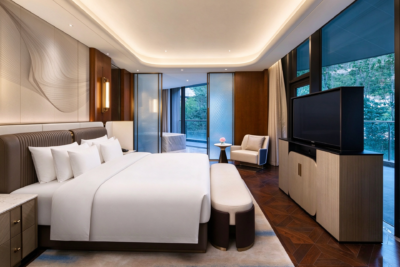 The first conversation with a hotel furniture factory should begin with the experience the property wants to create. A coastal resort, urban business hotel, boutique property, and extended-stay project may all need beds, wardrobes, desks, seating, and tables, but the design priorities will be different. One project may emphasize calm natural materials; another may require efficient work surfaces, durable public seating, or flexible room layouts.
Write a brief that connects the visual direction with operational needs. Include the hotel segment, room types, number of keys, public areas, restaurant or meeting spaces, target opening date, delivery location, and design status. Add the intended guest journey: what should guests notice when they enter the room, where will they work or relax, how will luggage be stored, and which furniture elements carry the strongest brand expression?
This approach gives the factory a meaningful basis for discussion. It also helps the design team distinguish between essential custom elements and standard components that can be adapted. The result is not simply a list of furniture. It is a coordinated package that supports comfort, circulation, maintenance, and visual identity.
MEITIAN hotel furniture supplier describes its work as OEM and private-label luxury hotel furniture manufacturing for global brands, hotels, and project developers. For any supplier, statements like this should be tested against the actual brief: ask what parts of the project can be developed, manufactured, inspected, packed, and supported under the proposed scope.
Evaluate design development as an engineering process
International hotel furniture projects often begin with renderings, mood boards, elevations, and material references. These documents communicate intent, but they do not always contain the information needed to manufacture and install a product. A capable hotel furniture factory should have a clear method for turning design intent into controlled production information.
Ask to see how the factory handles shop drawings, material schedules, hardware locations, tolerances, assembly details, and revision control. The review should cover more than appearance. It should answer practical questions: Will the wardrobe clear the door swing? Are the desk cable routes compatible with the electrical plan? Can the headboard be delivered through the lift? Can the nightstand be fixed safely? Will the vanity allow access to plumbing and maintenance points?
Questions for the engineering review
Request a drawing workflow that identifies the current revision, client comments, approval responsibility, and release status. Confirm how the factory records changes after a sample is approved. For built-in or integrated furniture, coordinate the furniture details with architectural, electrical, plumbing, lighting, and interior-finish information before production begins.
This stage is where a factory can either reduce risk or create it. A supplier that only repeats dimensions from a purchase order may miss conflicts that become expensive at the jobsite. A supplier that asks precise questions and documents decisions gives the owner and designer a stronger control point before materials are cut.
Test the factory through a representative room or furniture package
A factory presentation can show capability, but a representative test package reveals how the team actually works. Select a group of items that represents the project’s complexity: perhaps a bed wall, nightstand, writing desk, wardrobe, lounge chair, or restaurant table. Include at least one item with a difficult finish, tight tolerance, integrated service, or unusual assembly requirement.
Use this package to evaluate communication speed, drawing quality, sample accuracy, finish interpretation, and response to design comments. The objective is not to demand a free design service. It is to understand whether the factory can collaborate within a defined development process and produce information that the project team can approve.
For larger developments, a full-scale mock-up room may be appropriate. It allows the hotel owner, designer, operator, contractor, and factory to review the furniture in context. Door clearances, lighting, proportions, comfort, circulation, wall protection, hardware access, and installation sequence are easier to judge in a room than on a screen.
A mock-up should end with a written decision. Record approved dimensions, material references, finish standards, hardware, open issues, and permitted changes. The approved room or furniture sample should become a production reference, not merely a presentation moment.
Review materials and quality around hotel use
Hotel furniture has to perform in a demanding environment. Guestrooms are cleaned and reset repeatedly, drawers and doors are used by many people, luggage can strike corners, and public areas experience continuous traffic. The factory should therefore explain how materials, construction, upholstery, hardware, and surface treatments are matched to the intended application.
Instead of accepting broad descriptions such as “premium wood” or “commercial quality,” ask for a precise material and finish schedule. Identify the substrate, veneer or laminate, edge treatment, coating system, metal finish, glass or stone specification, fabric, foam, and hardware. For natural materials, define the approved variation range. For painted or stained surfaces, identify the control sample and viewing conditions.
Quality control should have multiple checkpoints: incoming materials, first article, in-process construction, finish inspection, pre-shipment review, and receiving inspection. Ask how defects are recorded, who approves corrective action, and how replacement parts are identified. A factory that can describe these checkpoints clearly is easier to coordinate than one that relies only on final photographs.
Destination requirements also belong in the technical review. Ask the factory to identify the documents and test evidence relevant to the materials, construction, and destination of your project. Requirements may differ by country, hotel brand, building authority, and product category, so compliance should be confirmed with the project’s local consultants, importing team, and appointed technical specialists. Keep the applicable requirements in the project specification and connect each document to the actual material or product it covers.
Check whether production can support the project schedule
A factory may be able to produce an attractive sample but still struggle with a multi-phase international order. Ask how the team plans material purchasing, prototype approval, batch production, inspection, packing, and release. Request a schedule that shows dependencies rather than one optimistic completion date.
The critical dependencies are usually design approval, finish approval, first-article approval, room-type confirmation, quantity freeze, and shipping release. Clarify what happens when one of these dates moves. Does the factory update the production sequence? Who identifies the impact on other room types? How are partial deliveries handled?
For an international hotel project, schedule discussions should include labeling and installation logic. Each package should be traceable to a building, floor, room type, item code, and quantity. If rooms will be handed over in phases, the furniture should be packed and released in a sequence that supports the contractor’s program. Ask whether the supplier can provide assembly information, hardware lists, touch-up materials, and spare-part recommendations.
MEITIAN Hotel Furniture catalog presents hotel bedroom, resort suite, and executive-room furniture resources, along with company and project materials. Use a catalog to start the product conversation, then request a project-specific schedule and item-by-item production plan.
Assess communication across the international project team
The best hotel furniture factory is not necessarily the one with the largest product gallery. It is the one that can communicate reliably with the people who make decisions and the people who install the furniture. Establish who owns technical questions, commercial changes, quality issues, packing documents, and after-sales cases.
Agree on practical communication rules: one drawing register, one finish schedule, a defined approval channel, meeting notes, response times for open questions, and a method for highlighting changes. Ask how the factory will communicate a material shortage, finish variation, damaged component, or production delay. Early visibility gives the project team more options; late surprises usually reduce them.
Also assess whether the factory understands the different priorities of the owner, operator, designer, contractor, and procurement team. The owner may focus on brand consistency and life-cycle value. The designer may focus on proportion and finish. The contractor may need installation clarity and dimensional certainty. The operator may care about cleaning, replacement, and room turnover. A successful supplier helps these requirements meet in one coordinated package.
Compare the factory on project value, not only price
A useful comparison matrix should include design development, shop drawings, samples, materials, hardware, inspection, packaging, delivery terms, installation support, spare parts, warranty handling, and replacement procedures. Ask each factory to identify exclusions and assumptions. This prevents a low initial price from appearing comparable when it leaves important work outside the quotation.
Consider the cost of a design error, a damaged finish, a missing hardware set, a late room release, or an item that cannot pass through the site access route. These risks may not appear in the unit price, but they affect the project’s total value. A transparent factory can help the procurement team make those risks visible before appointment.
MEITIAN identifies its hotel furniture project manufacturing focus and provides a channel for project inquiries. When requesting a proposal, send the property brief, furniture schedule, drawings, finish references, quantities, delivery location, target dates, and destination requirements. A complete brief supports a more useful comparison than a request for a general price list.
Discuss your international hotel furniture project
MEITIAN Hotel Furniture Manufacturer positioning is clear: We design and manufacture bespoke hotel furniture that transforms spaces into unforgettable guest experiences. If you are developing an international hotel project, send the team your design brief, room schedule, drawings, finish references, quantities, destination, and key dates. Visit the us to start a project-specific conversation about bespoke hotel furniture, technical coordination, quality control, and delivery planning.
📧 sales@fsmeitian.com
🖥️ https://fsmeitian.com
📞 https://wa.me/8613411804160